Kansas City is known for its wood-destroying pests like carpenter bees, termites, and carpenter ants. Because carpenter ants and termites are so similar, it can be challenging to determine what kind of infestation you’re experiencing. Misidentifying the pest infestation can make the pests difficult to treat and lead to longer-term challenges, and that’s why it’s crucial to understand the difference and count on professional inspection for proper treatment.
Identifying Carpenter Ants
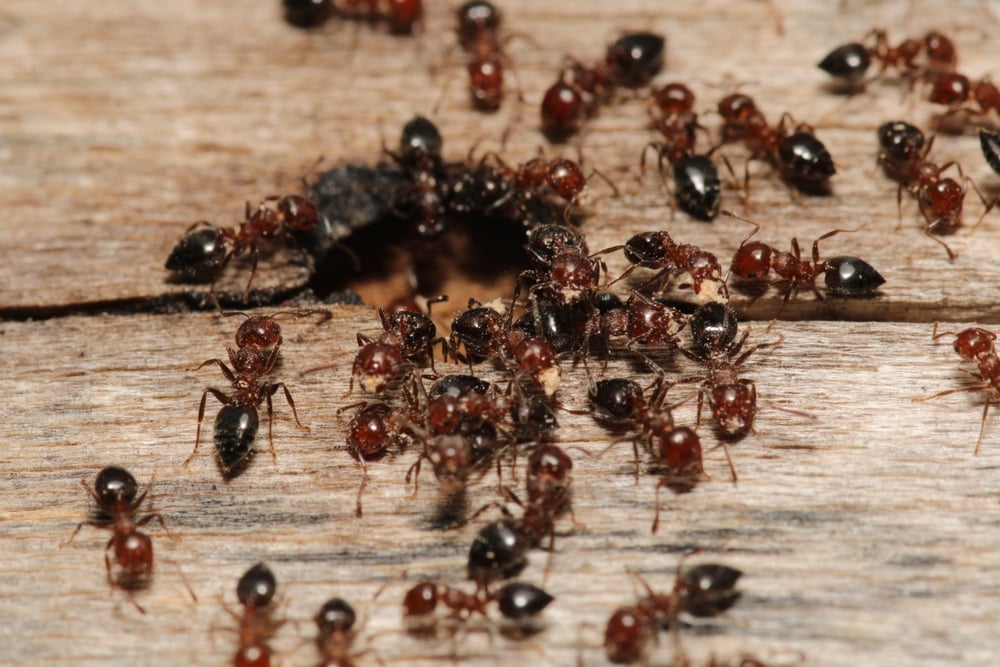
Carpenter ants can be especially difficult to identify. Why? Their damage can be confused with termite damage, and their appearance can be confused with another, less destructive ant species. Carpenter ants are most active in the late summer months as they venture indoors in search of food and water.
Appearance
Carpenter ants can vary significantly in both their size and color, which means that distinguishing them from other ants can be difficult. Professional carpenter ant inspections identify them by their rounded thorax and heart-shaped head. Reproductive males and queen carpenter ants have two pairs of transparent or light brown wings, with the front wings slightly larger than the hind wings.
Behavior
Because both ants and termites swarm in the spring, carpenter ants are often mistaken for termite swarmers. Carpenter ants, however, are more likely to be seen out and about. Carpenter ants burrow into wood not to eat the wood, but to build a nest. Because of this, you may find carpenter ants scavenging for food around your home.
Identifying Termites
Subterranean termites (the most common termite species in Kansas City) are most active in the summer. However, they can remain active in colder months if they have already established themselves in a heated building, making it important to never wait for a termite inspection.
Appearance
While carpenter ant wings vary in size, termites have four wings that are uniform in size and much longer than their body. Termites also have rectangular bodies with no waist definition, further contrasting them from the sectioned bodies of carpenter ants. Worker termites are even more distinct from carpenter ants, with their near-transparent white bodies compared to the dark, opaque coloration of carpenter ants.
Behavior
While you may see termite swarmers during the spring, termites shed their wings and hide in mud tubes once they have begun to establish a colony. Termites rely heavily on moisture in soil and wood to survive. Since they get the nutrients they need from the wood they eat, termites won’t leave their colony to forage.
Damage Patterns: How to Tell if It’s Termites or Carpenter Ants
While both termites and carpenter ants burrow through wooden structures, their damage patterns differ. One of the biggest differences is that termites actually consume the wood as they burrow through it. Carpenter ants gnaw through wood and push the excess wood shavings and frass out of the tunnel behind them, leaving piles outside of their holes. Ants create smooth tunnels, usually following along the wood grain. Termite tunnels are more erratic, as they quickly consume wood and leave behind mud residue.
Signs of a Termite Infestation
- Mud tubes leading up to damaged wood
- Piles of wings from swarmers
- Messy, maze-like burrows through wood
- Signs of significant structural damage (peeling paint, sagging drywall, etc.)
- Hollow-sounding wood
- NO droppings (subterranean termites use their droppings as building materials)
Signs of a Carpenter Ant Infestation
- Ants inside the home (especially large, winged ants)
- Piles of wood shavings and frass
- Smooth, straight burrows through wood
- Faint rustling sounds inside wooden structures or walls
- Loosely packed droppings with a mix of wood and fecal matter
The Importance of Professional Inspection for Termite and Carpenter Ant Control
Misidentifying a pest infestation risks improper treatment that won’t fully address the issue. Just because you have ants in the home and damaged wood doesn’t mean you don’t have termites, since termite activity can attract many other pests. The Advantage Termite and Pest Control team brings vast expertise and experience in identifying and effectively treating both termites and carpenter ants, eliminating the problem at its source and protecting your property against reinfestation.
Both carpenter ants and termites can cause significant damage to wooden structures before obvious signs of an infestation appear, making it pertinent that you don’t wait to seek professional help. Advantage Termite and Pest Control offers custom service plans tailored to your needs, with ongoing programs to keep your home pest-free.
Don’t let termites or carpenter ants establish themselves in your home. Contact Advantage Termite and Pest Control now for a free inspection and estimate. Call us at first sight – we do it right!